Peter Kuipers Munneke
Polar scientist
About me

I am a scientist in the field of glaciology and polar meteorology at the Institute for Marine and Atmospheric research Utrecht (IMAU), part of Utrecht University, The Netherlands. I'm active on Mastodon.
Featured paper: NAO and Greenland firn
The large-scale weather pattern over the North Atlantic is variable, and it impacts Greenland surface mass balance, and firn mass. We find that a more positive phase of NAO (i.e., more zonal flow) since 2012 has slowed down the loss of firn over most of the ice sheet.
Blue ice in Antarctica
Using a spectral unmixing technique, we map daily fractions of blue-ice area over Antarctica for the 22-year period since 2000, using the full available MODIS archive. This FABIAN product is published in Remote Sensing of Environment.
Expeditie Weerklank 2023/24
Afgelopen maanden trad ik met toppianist Ralph van Raat op met ons theaterprogramma Expeditie Weerklank. We namen je mee naar de duizelingwekkende wereld vol natuurkunde die schuilgaat achter het weer, en vertelden alles over regenbogen, bliksemschichten, hagelstenen en lagedrukgebieden. Ralph van Raat omlijstte dit wervelende programma met prachtige bijpassende stukken van onder andere Tsjaikovski, Liszt, Debussy, Berio en Sciarrino. Een teaser van dit programma was te zien op tv bij Podium Klassiek (vanaf 14'05).
| Speeldata | |
The IMAU-FDM firn model
The Greenland and Antarctic ice sheets are covered by a thick blanket of firn, the transitional material between snow and ice. Firn is the crucial interface between the atmosphere and the ice sheet. Every change in the atmosphere - global warming, changes in snowfall - first impacts the firn, and then the rest of the ice sheet. At IMAU, we have developed a firn model - IMAU-FDM - that simulates relevant processes in the firn, including compaction, meltwater percolation and refreezing, and the entire thermodynamics of the firn. In this way, we simulate the entire firn layer over the ice sheets. As a bonus, we track thickness changes of the firn, which allows us to correct altimetry observations for firn thickness changes. Find more background, publications, and data here -->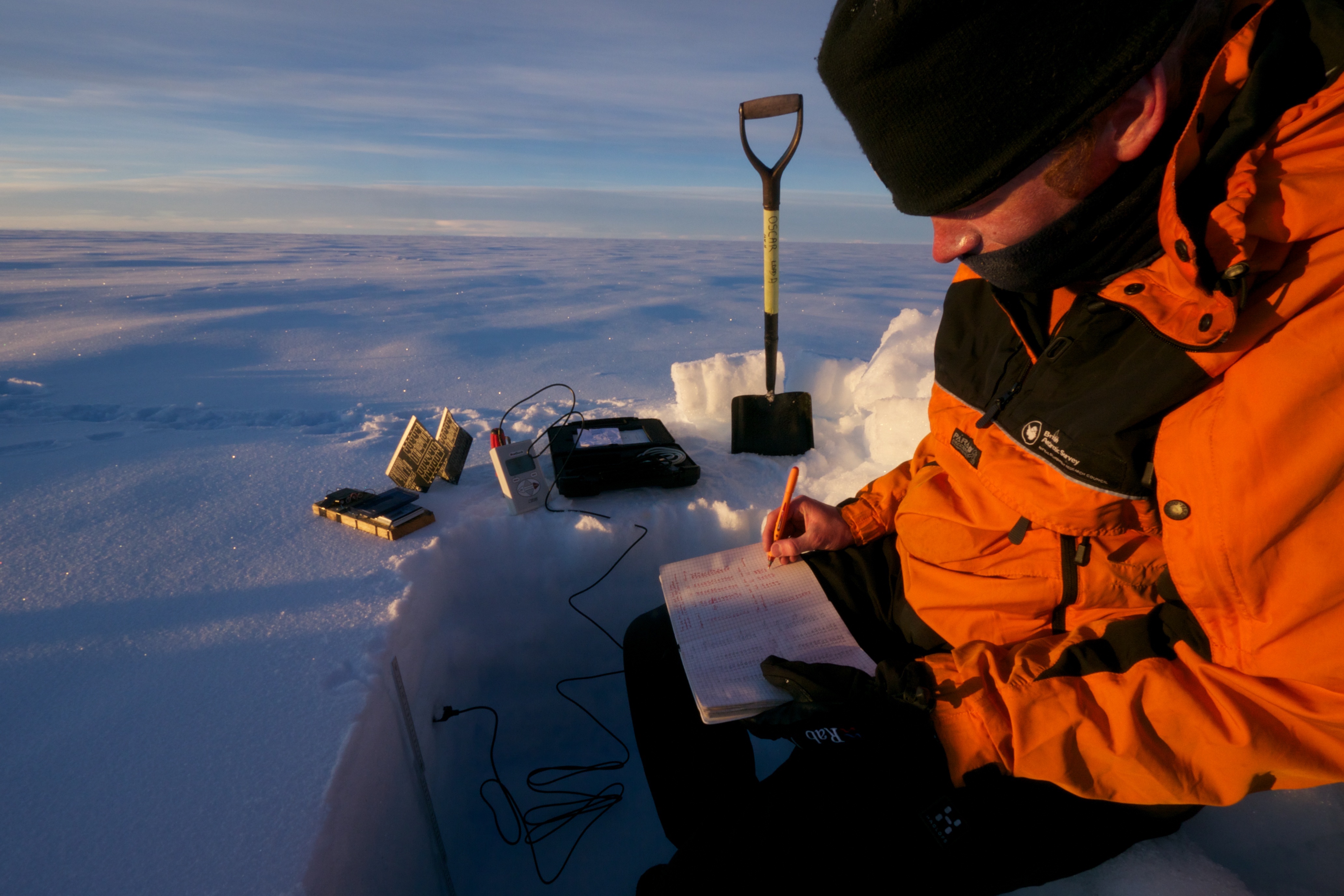
Atmospheric circulation impacts Greenland firn
In a new study, my colleague Max Brils unravels how variations in weather patterns over the North Atlantic have an impact on the thickness, growth and demise of the firn layer on the Greenland Ice Sheet. After a record mass loss of firn in 2012, a more zonal flow (positive North Atlantic Oscillation (NAO)) allowed the firn in some places to regain some mass. In other places, the coupling between NAO and firn thickness is absent, weak, or different. Also, the variation of NAO throughout the year causes the amplitude of firn thickness variation to be largest in southeast Greenland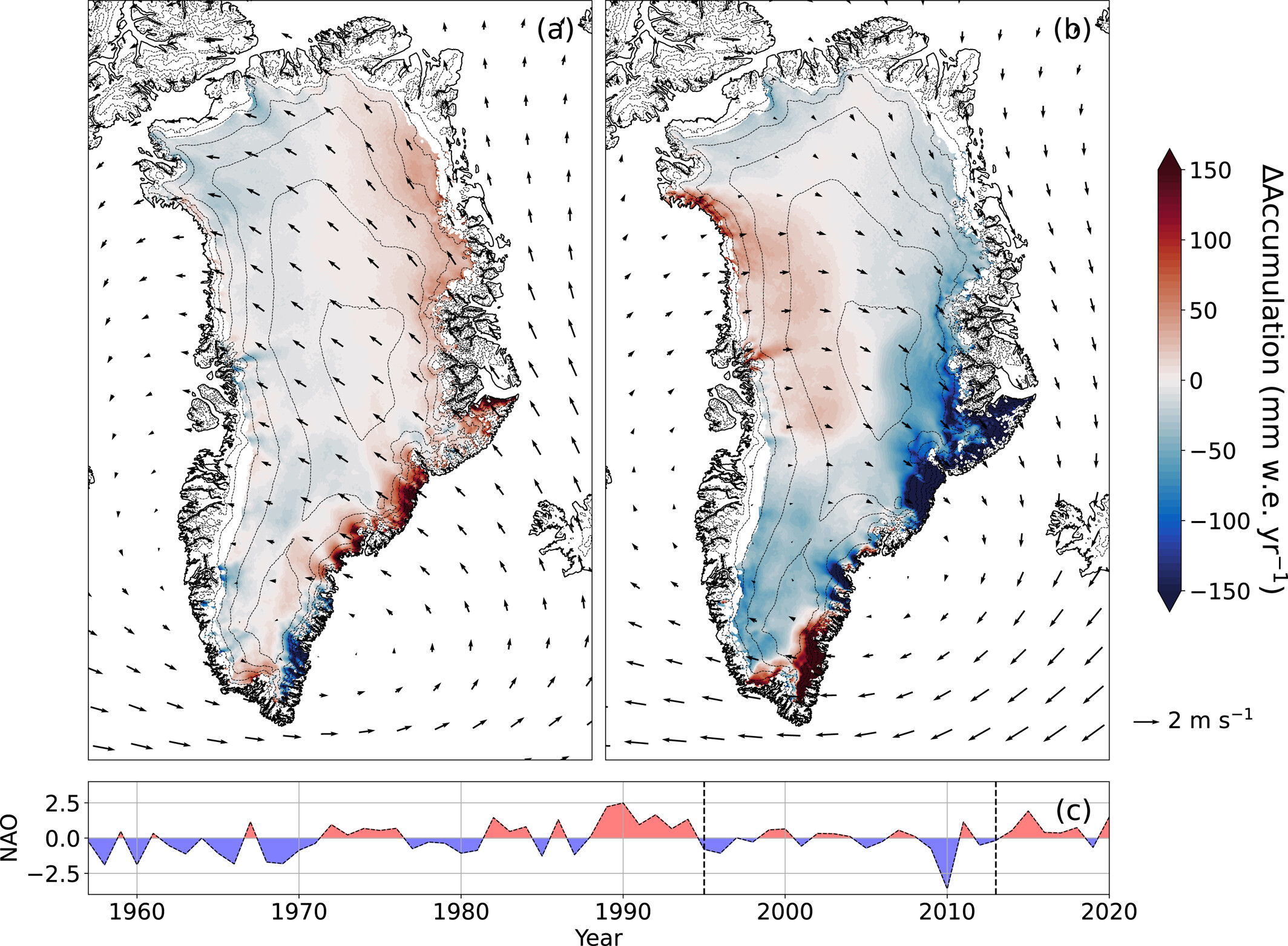
Snowfall during positive (left) and neutral (right) NAO conditions.
How much does it snow on Larsen C?
The answer is: about 7,000,000,000,000,000,000 snowflakes per year. But how do we know? And why do we care?
In July 2017, a 6000 square kilometre iceberg broke off the Larsen C ice shelf. Is this the beginning of the collapse of the entire shelf? An important question, which some try to answer with models. But these models need input data. Like the amount of snowfall added to the surface of the shelf. Our best estimate of that number uses a lot of field data, and a polar climate model. Read more -->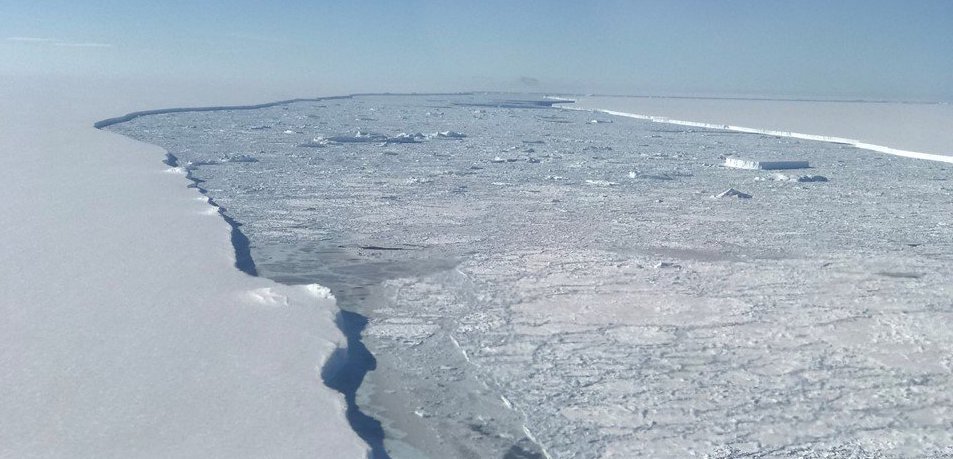
The iceberg A68 (right) and the Larsen C (left) from Operation IceBridge plane (photo: Nathan Kurtz)
The future of melt in Antarctica
Extensive melt ponds are not a very common sight on the cold Antarctic continent. Not yet, at least. According to our study, the amount of snowmelt could grow eightfold by 2100 if current greenhouse gas emissions are not sufficiently curbed, with potentially dire consequences for the stability of large ice shelves, and the contribution of the Antarctic ice sheet to sea-level rise. Read more -->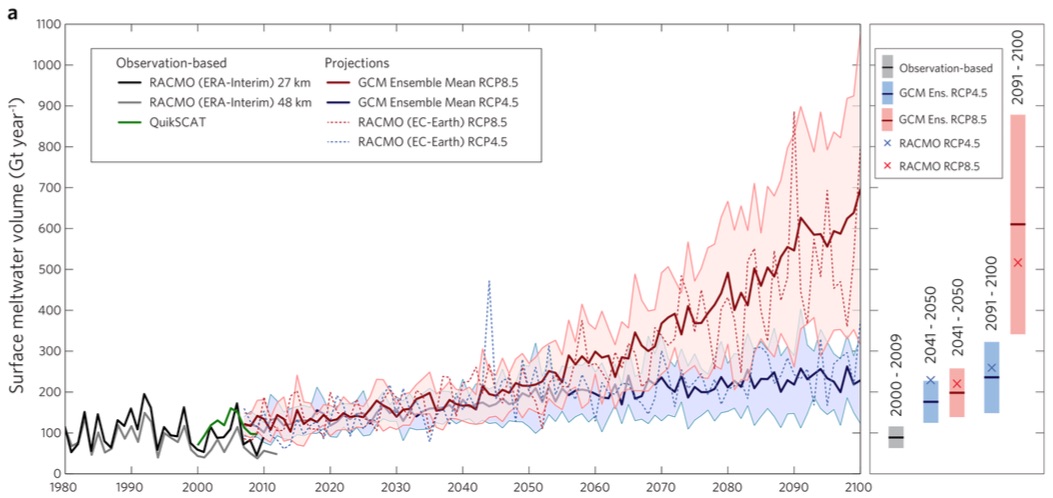
Future melt with (blue) and without (red) emission reductions
Warm winds cause ice-shelf melt
Any skier will know that strong winds over a mountain range usually bring warm, balmy weather to its leeward side, causing rapid snowmelt and generally deteriorating skiing conditions. Moist air is first pushed up onto the mountain, where moisture is lost through snowfall. The dried-out air heats up as it descends along the leeward slope of the mountain. We found that such föhn winds create a remarkable pattern of meltwater lakes in the glacier inlets just downslope of the Antarctic Peninsula mountain range on the Larsen C Ice Shelf. These meltwater lakes could make the ice shelf unstable, by leaking into and opening up cracks and fissures within the ice shelf. Read more -->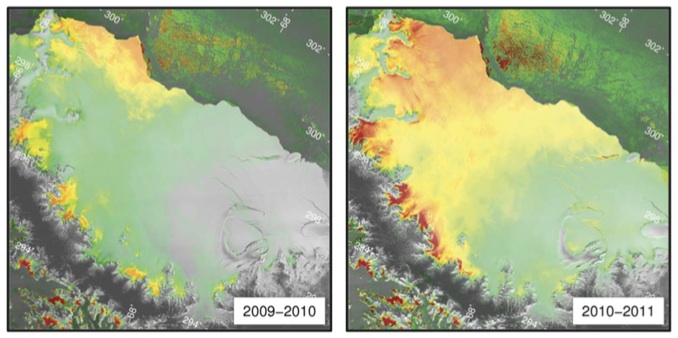
Envisat ASAR images of melt season length over Larsen C Ice Shelf, Antarctica.
How meltwater survives the Greenland winter
Scientists have been excited about the discovery of a giant meltwater storage within the firn layer on the Greenland Ice Sheet. I and my colleagues provide an explanation for the formation of these so-called firn aquifers (Kuipers Munneke et al., GRL). They form in high-accumulation areas, where large amounts of fall and winter snow bury the summer meltwater sufficiently fast to isolate it from the harsh Greenland winter cold. Read more -->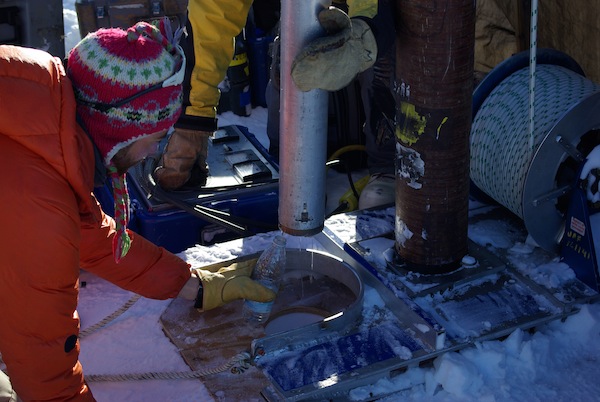
Drill filled with dripping, water-soaked firn. Photo by Ludovic Brucker
Disappearing snow increases risk of collapsing ice shelves in Antarctica
(EN) A number of floating ice shelves in Antarctica are at risk of disappearing entirely in the next 200 years, as global warming reduces their snow cover. Their collapse would enhance the discharge of ice into the oceans and increase the rate at which sea-level rises. A rapid reduction of greenhouse gas emissions could save a number of these ice shelves. Read more -->
(NL) Drijvende ijsplaten rondom Antarctica lopen een groot risico in de komende 200 jaar te verdwijnen, omdat hun sneeuwlaag verdwijnt door de opwarming van de atmosfeer. Hierdoor zal de ijskap sneller gaan stromen en de zeespiegel verder stijgen. Een snelle reductie van de uitstoot van broeikasgassen vergroot de overlevingskansen van een deel van de ijsplaten. Lees meer -->
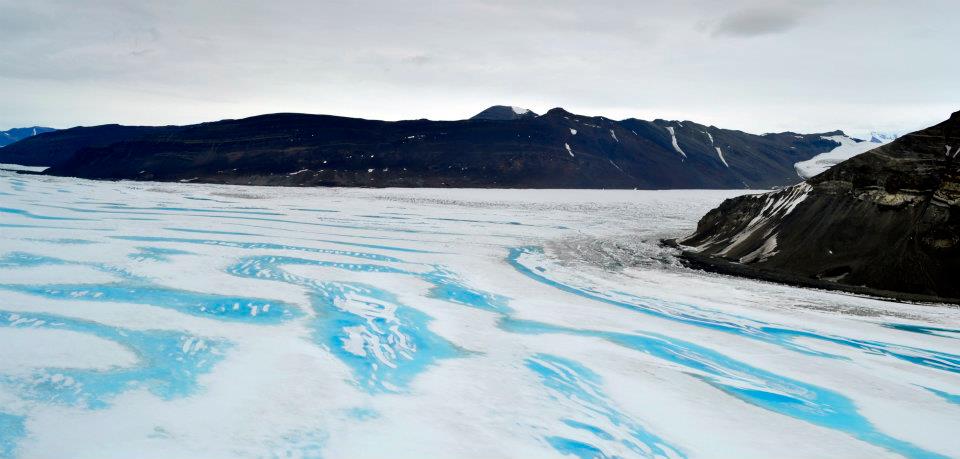
Melt ponds at George VI Ice Shelf / Smeltmeren op George VI IJsplaat, Antarctica.
Modelling surface melt in Antarctica
In 2010, I established a snowmelt climatology of the Antarctic continent, using satellite observations (SSM/I) and the regional climate model RACMO2.1/ANT. The latter model was run on a 27x27 km resolution for the period 1979-2010. We have quantified the meltwater volume at 89 Gigatonnes per year. This is a minor component of the mass budget of the Antarctic Ice Sheet, as is widely known: the total mass of Antarctica is mainly determined by snowfall (gain) and ice discharge by icebergs (loss). Recent mass loss from the Antarctic Ice Sheet is mainly caused by increased basal melting and ice discharge. The amount of meltwater is relevant however, as it may play an important role in weakening ice shelves. We found no significant change in meltwater volume between 1979 and 2010, partly because of the large interannual variability. Kuipers Munneke et al., 2012, Geophysical Research Letters, doi:10.1029/2011GL050207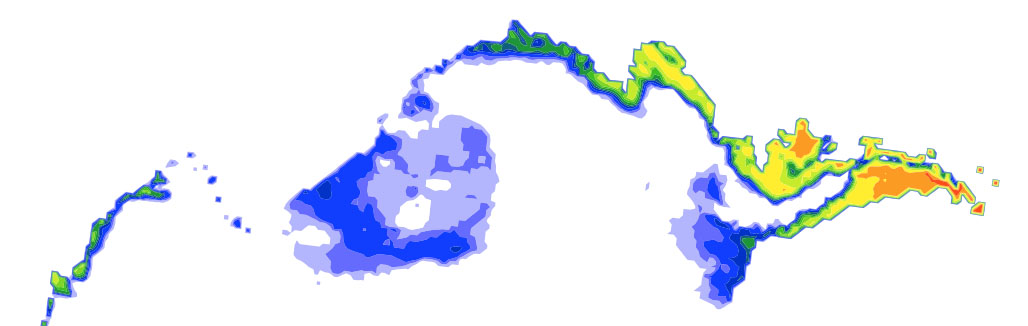
Larsen C 2011
In January 2011, a successful glaciometeorological measurement campaign was held on and around the Larsen C ice shelf in the Antarctic Peninsula. We studied the impact of föhn winds on the surface energy budget of the Larsen Ice Shelf. It is thought that föhn winds cause clear skies and warm air over the ice shelf, enhancing the melt. The increase in melt in this region may be connected to an increase in westerly winds. The experiment was conducted by the BAS (British Antarctic Survey), University of Leeds, Unversity of East Anglia, and the IMAU contributed with instruments for measuring radiation, turbulent fluxes, and liquid water content. A field report is available. Read more -->
Snow and ice albedo
Much of my initial research focused on the albedo of snow and ice surfaces. As small changes in snow albedo have a profound effect on the radiation budget of a glacier surface, understanding the causes of albedo variations is important. To that end, I studied snow albedo, using both models and measurements. I wrote my PhD thesis on the albedo of snow and ice. Read more -->
Summit Radiation Experiment 2007
In the summer of 2007, we organized a field campaign at Summit Camp, the highest research station in Greenland. We aimed to investigate the energy and radiation balance of a polar snow surface. We found out that a significant part of summer heating of the snowpack is caused by the absorption of sunlight below the surface, detailed in this paper. More about the Summit Radiation Experiment (SURE 07) can be found here -->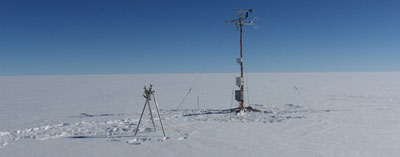
Automatic Weather Station at Summit, Greenland, during SURE07.
About me
I am working as a research scientist in the Ice and Climate research group at IMAU. In the recent past, I have been working on surface mass and energy balance of the ice sheets, snow and ice albedo, solar radiation, and meltwater. At the moment, I am investigating the evolution of the firn layer over the ice sheets of Antarctica and Greenland. My general research interests are polar meteorology, surface mass balance modelling, atmospheric radiation, firn processes, and ice-shelf stability.
I am active on Mastodon (@PKuipersMunneke@mastodon.nl), tooting about weather, climate, climate change, and glaciology, both in Dutch and in English.