Next: Utrecht astronomy Up: What's past? Previous: Claim to fame Contents
A direct consequence of the closure of the SIU was that the planned bundling of NOVA's optical and infrared astronomy instrumentation groups at Utrecht fell through. Another consequence is that the Dutch institute for space research (SRON) decided to move away from Utrecht. The termination of astronomy didn't even improve the UU budget because the gain from firing the 10 SIU fte's amounted to less than the losses in direct government funding (for student influx and PhD production) and indirect and external funding (from NOVA, NWO, TNO, STW, EC, ERC, ESA, NSF, NASA).
The worst aspect was the diminishing emphasis on science at Utrecht University. The Dutch economy should become a “knowledge” economy, but this rosy goal is severely hampered by severe undereducation in the technical and exact sciences. The overall quality is still high but the volume is much smaller per capita or GNP than in comparable (and competing) countries. Cutting down on a prestigious exact science in which the Dutch excel extraordinarily and which attracts more public attention than any other (with NOVA's outreach program exemplary as well) is a bad mistake with respect to inspiring bright high-school pupils to choose an exact-science education. Counter example: at Nijmegen University (which accepted half of the SIU's staff, a sizable increase of its astronomy department) the restart of astronomy substantially increased the influx of physics students. Utrecht University indeed suffered the reverse. Not a win-win strategy but a lose-lose lack of perspective. At the SIU's formal burial ceremony in the packed UU aula, SIU director C.U. Keller reminded the audience that the most abundant element in the universe after hydrogen is stupidity.
How did the closure come about? It seems that in 2010 the notoriously autonomous UU board (“College van Bestuur”, CvB, a dictatorial body operating without checks or balances) decided that the SIU was too small for a Masters-education discipline and proposed in secret to move the similar-sized Amsterdam and Nijmegen astronomy departments to Utrecht - meeting indignant rebuttal. What happened thereafter is detailed in this account by C.U. Keller. The CvB set up a secret evaluation panel which advised to maintain the SIU; in December 2010 the CvB signed an agreement to do so and strengthen the SIU. However, in June 2011 the CvB decided to kill it, without consulting anybody wherever. Its non-disclosed motivation seems to have been that Utrecht University would profile itself favorably by not doing what others do - i.e., by single-handedly withdrawing from this nation-wide, exemplary, government-endorsed, student-attracting, top-level science endeavour. The CvB ignored the government's acclaim for NOVA and desire for more exact-science students. It literally shut its door and telephone to the NOVA directors even though it was the formal NOVA lead agency. It forced a freshly-appointed science-division dean (replacing a less timid one who resigned in protest to the CvB's science policies) to terminate the SIU, against his own judgment. Its only public announcement was, quite hypocritically, that it “respected the dean's decision”.
The subsequent deal, orchestrated by SIU director C.U. Keller and NOVA director W.H.W.M. Boland, to transfer most SIU astronomers to other NOVA universities, at large UU cost to guarantee their tenure, was officially concluded in March 2012. However, by February most astronomers had already left. Namely professors A. Achterberg (theoretical astrophysics, to Nijmegen), C.U. Keller (polarimetry instrumentation and solar physics, to Leiden), F.W.M. Verbunt (high-energy astrophysics, to Nijmegen), and the other permanent staff S.S. Larsen (galaxy evolution, to Nijmegen), O.R. Pols (stellar evolution, to Nijmegen), M.C. van den Berg (education, to Amsterdam), J. Vink (supernovae, to Amsterdam), A. Voegler (solar magnetohydrodynamics, left research). NOVA-paid instrumentalists F.C.M. Bettonvil and F. Snik moved to Leiden. Support staff S.J. Hogeveen and M. Wijburg accepted other jobs at Utrecht University.
At this loss of its close partner SRON decided to leave Utrecht. It first selected Amsterdam but then found better connections at Leiden (astronomy there, technology in Delft) and moved to a new building on the Leiden science campus in 2021.
Upshot: Utrecht astronomy is gone, including Utrecht (read Dutch) solar physics. UU astronomy education ended in June 2012. No more interest in the Universe at Utrecht “University” (it scrapped its subscriptions of the major astronomy journals). Less student attractivity. No more well-educated UU astronomy alumni enriching society. No more UU astronomy outreach - in which Utrecht astronomers were particularly active ever since Minnaert; the group that went to Leiden won the national “Academische Jaarprijs” for science popularization soon after their move.
By the end of 2011 the CvB had also announced new overall priority themes for Utrecht University: “sustainability”, “life sciences”, “institutions” [sic], “youth & identity” [sic]. In this vision the exact (beta) sciences vanish apart from “useful” applications such as medical and climate physics. UU's much-touted relatively high initial Shanghai ranking was earned in hard natural sciences, in particular theoretical physics and crystallography. Nevertheless, in 2011 UU's administration also contemplated termination of theoretical physics and pure mathematics. A climate in which the best researchers leave first, as indeed happened in these fields (they went to Nijmegen). Utrecht University went soft and mediocre. Its chemistry and physics are now negligible Shanghai scorers, public administration highest.
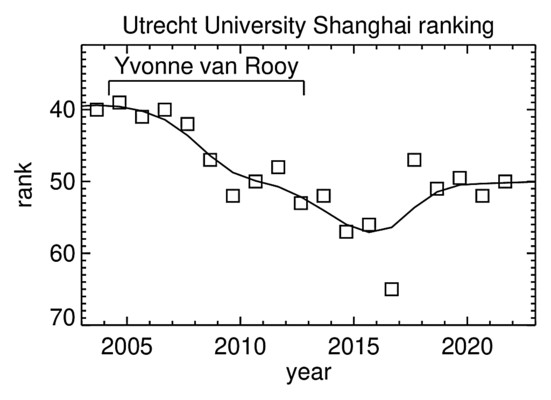
The responsible CvB chair, Yvonne van Rooy, had a humanities-only (gymnasium-alpha) education, characteristic of high-school pupils that stumble over mathematics and physics to become specimens of C.P. Snow's classic “Two Cultures” syndrome: intellectuals who proudly assert that not knowing the second law of thermodynamics adorns their intellectuality. She left Utrecht University in 2012, leaving as heritage the dramatic plunge of Utrecht University quality charted below. She bragged about the minor 2009-2011 rise at the time she terminated astronomy, but the plunge persisted years after her reign and stabilized at 25% loss of quality ranking.